practical guide
How far out should I be ordering a bridal gown so it lands before the first fitting?
Designer production windows, shipping, and your own alterations calendar all stack. Here is how to work backward from the wedding date and build the buffer that keeps a rush cut off the invoice.
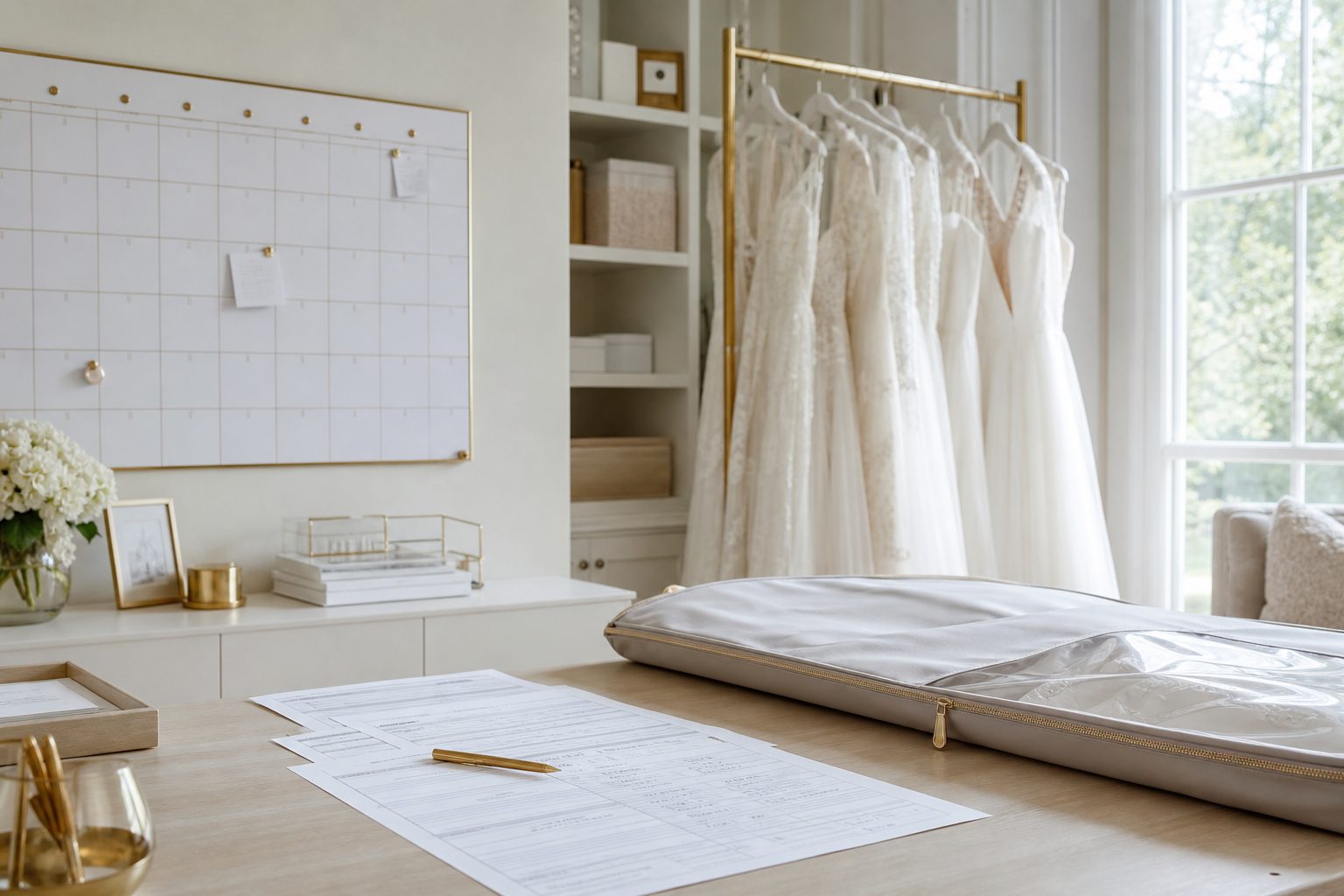
For a standard special order from a US bridal designer, place the order so the gown arrives in your shop at least twelve weeks before the wedding. Working backward, that usually means ordering nine to eleven months out. The production window is the big block, but it is not the only one: you also need transit time, a receiving and inspection buffer, and enough calendar left for two or three fittings with pressing and steaming at the end.
The trap is treating the designer's quoted window as the finish line. A quoted twenty week window starts when the order is confirmed and paid, not when the bride signs your contract, and it ends when the gown ships from the manufacturer or the US warehouse, not when it lands on your rack. Two weeks disappear on either side before anyone notices.
Below is how to build the date backward, where to hold your buffer, and what to say when the wedding date simply does not allow it.
What a designer actually means by a 20 to 24 week production window
Most bridal houses quote production in weeks, and most quote a range because cut dates are batched. Your order joins a cutting group with other orders in that style and size range. If you miss a cut date by two days, you are not two days late, you are into the next batch.
The clock generally starts at order confirmation, which for most houses means the order form is received, the size is locked, and the wholesale deposit has cleared. If your bride is still deciding between a size 12 and a size 14, the clock has not started. If she wants a hollow to hem measurement outside the standard range, the order is often flagged as a custom length and may be quoted separately.
The window generally ends at ship, not at delivery. Add ground transit from the designer's US distribution point, typically two to seven business days. Some houses ship direct from overseas production and the gown clears customs before domestic transit, which adds unpredictable days you cannot schedule around.
The pieces the window does not include
- Your own receiving and inspection: unbagging, checking the style and size tag against the order, checking for shipping damage, hanging to relax creases.
- The call to the bride and the scheduling gap before she can come in.
- Any replacement cycle if the gown arrives wrong or damaged, which is a fresh production window unless the house expedites.
Keep reading: Should I price alterations by the piece or by the hour in my bridal shop?
Working backward from the wedding date to a safe order-by date
Here is the arithmetic laid out. These are assumptions you should replace with your own shop's real numbers, but the structure holds.
| Block | Weeks | Running total before the wedding |
|---|---|---|
| Wedding day and final press or delivery | 1 | 1 |
| Final fitting and steam | 2 | 3 |
| Second fitting and finish work | 3 | 6 |
| First fitting and initial cutting | 4 | 10 |
| Receiving, inspection, scheduling gap | 2 | 12 |
| Transit from warehouse | 1 | 13 |
| Designer production window (high end) | 24 | 37 |
| Your own order processing and deposit clearing | 1 | 38 |
Thirty eight weeks is roughly eight and a half months. Add a four week safety buffer for a batch slip or a replacement scare and you land at forty two weeks, just under ten months. That is why the ten month rule of thumb keeps showing up in bridal shops: it is not superstition, it is the sum of the blocks.
Run the same table with a twenty week production window and no safety buffer and you get thirty four weeks, or just under eight months. That is the aggressive end. It works when nothing slips.
Where the fitting schedule sits inside the timeline
The first fitting is the hinge. Everything before it is out of your control and everything after it is entirely inside it. Book the first fitting eight to ten weeks before the wedding for a straightforward gown, and ten to twelve for anything with beading, boning, or a corset back conversion.
The reason to hold at eight weeks rather than pulling the fitting forward is body change. Brides lose or gain in the last stretch, and a gown cut to a June measurement in February gets recut in May. You pay for that recut in seamstress hours whether or not you bill for it.
The reason not to slide past eight weeks is your own bench. A single seamstress working forty hours can carry a certain number of gowns in finish stage at once. If four May brides all hit final fitting in the same week, someone works a Sunday.
A simple booking rule
- At order placement, write a target first fitting week on the order, not a date.
- When the gown arrives, convert that week to a real appointment on the board within two business days of the call to the bride.
- Book fitting two and the pickup date at the same appointment, before she leaves the room.
Booking all three at once is the single highest leverage habit in a bridal fitting room. It converts a vague intention into three occupied slots on your seamstress calendar, and it stops the bride from calling in April asking for a Saturday you sold in January.
Keep reading: What goes wrong when a bride brings her own seamstress into my alterations process?
Rush cut fees: when the designer charges and who absorbs it
A rush cut is the designer pulling your order out of normal batching and cutting it ahead. Houses price this differently. Common structures are a flat dollar fee per gown, a percentage uplift on wholesale, or a tiered fee that climbs as the requested delivery date gets closer.
The important question is not the amount, it is who pays. Three cases:
- The bride's date created the rush. She shopped at seven months for a gown with a twenty two week window. The fee is hers, quoted before the order, in writing, on the same page as the gown price.
- Your delay created the rush. The order sat on the desk for eleven days over a holiday week. You absorb it. Absorbing it quietly is cheaper than the review.
- The designer's delay created the rush. A batch slipped and the house is expediting to recover. That is not a rush cut, it is a remedy, and you should not be invoiced for it. Ask.
Quote the rush fee as a line item, never rolled into the gown price. A bride who sees a separate rush line understands she is buying time. A bride who sees only a higher total thinks she was upsold.
Special orders versus off the rack from your sample rail
When the calendar is short, your sample rail is the answer, not a faster special order. A sample sells today, goes into alterations this week, and removes the production window from the equation entirely.
The tradeoffs are real and you should name them at the counter. A sample has been tried on, sometimes hundreds of times. Expect hem soil, underarm marks, a pulled bead or two, and a broken zipper foot. Price it accordingly and disclose the condition in writing.
The alterations bill on a sample is also usually higher, because you are fitting a specific body to a specific existing garment rather than ordering the closest size and taking it in. A sample two sizes too large in the bodice is a rebuild, not a nip.
See how VeilFittings handles this for bridal retail and alterations
Discontinued styles and dye lot risk on a late order
Late in a season, two risks stack. The first is discontinuation: the house drops the style at the end of a collection cycle and your order comes back unfillable weeks after you took a deposit. Confirm style availability with the house before you take money, not after.
The second is dye lot. Ivory is not one color. Light ivory, ivory, and diamond white vary between production runs, and they vary between the gown and separately produced accessories. If a veil, a jacket, or a belt is ordered on a different date than the gown, they may not match under the same light.
The fix is boring and effective: order coordinating pieces on the same purchase order as the gown wherever the house allows it, and when you cannot, tell the bride plainly that a separately ordered veil may read slightly different and offer to check it against the gown in your window light before she commits.
What to tell a bride whose date leaves no room
She is standing in front of you at five months out with a picture on her phone. You have three honest options, and the way to present them is as a menu, not a lecture.
- Buy the sample. Available now, discounted, condition disclosed, alterations start this month.
- Special order with a rush cut. Quote the fee before she falls in love with the style, and be explicit that a rush cut compresses your alterations window, so fittings will be tighter and reschedules will be hard.
- Choose from stock styles the house holds in a domestic warehouse. Not every designer offers this, but the ones that do can ship in days rather than months.
What you should not do is take the order and hope. A gown that arrives four weeks before the wedding is not a sale, it is a refund conversation with a bride in tears and a designer who will not take a return on a cut-to-order garment.
Building the order-by date into your intake paperwork
The order-by date belongs on paper at the consultation, before the gown is chosen. Print the wedding date at the top of the intake form and calculate the latest safe order date next to it. When the bride sees that her date requires an order by March 14, the conversation about deposits gets much easier.
Your order form should carry, at minimum: wedding date, designer and style, size ordered and the measurements it was based on, the house's quoted window with its start and end definitions, your calculated arrival week, the target first fitting week, and any rush fee with a signature line beside it.
The failure mode in most shops is a form that lives in a folder nobody opens between order and arrival. Keeping the order-by date, the expected arrival week and the fitting slots on one shared board is exactly what VeilFittings is built to do: every gown from deposit to pickup, with the alteration appointments and the seamstress workload sitting in the same view, so the week a batch slips you can see immediately which fittings have to move.
Read also
Should I price alterations by the piece or by the hour in my bridal shop?
Flat per-task menus read cleanly to a bride but bleed margin on couture. Hourly protects the seamstress and unsettles the customer. A working comparison of both models for a bridal fitting room.
What goes wrong when a bride brings her own seamstress into my alterations process?
Outside alterations are common and legitimate, but they blur liability on a gown you sold. The handoff mistakes that turn into a chargeback, and the release language that prevents them.
Do I need to collect sales tax on alterations if the gown was purchased in my store?
Taxability of alteration labor varies by state and often turns on whether the service is bundled with the sale of the gown. How to read your own state rule and invoice correctly.