case study
How does a small bridal boutique actually run a designer trunk show without losing money?
A trunk show brings a full collection and a hard weekend deadline. A walk through the real cost lines, the appointment structure, and where a three day event turns profitable or not.
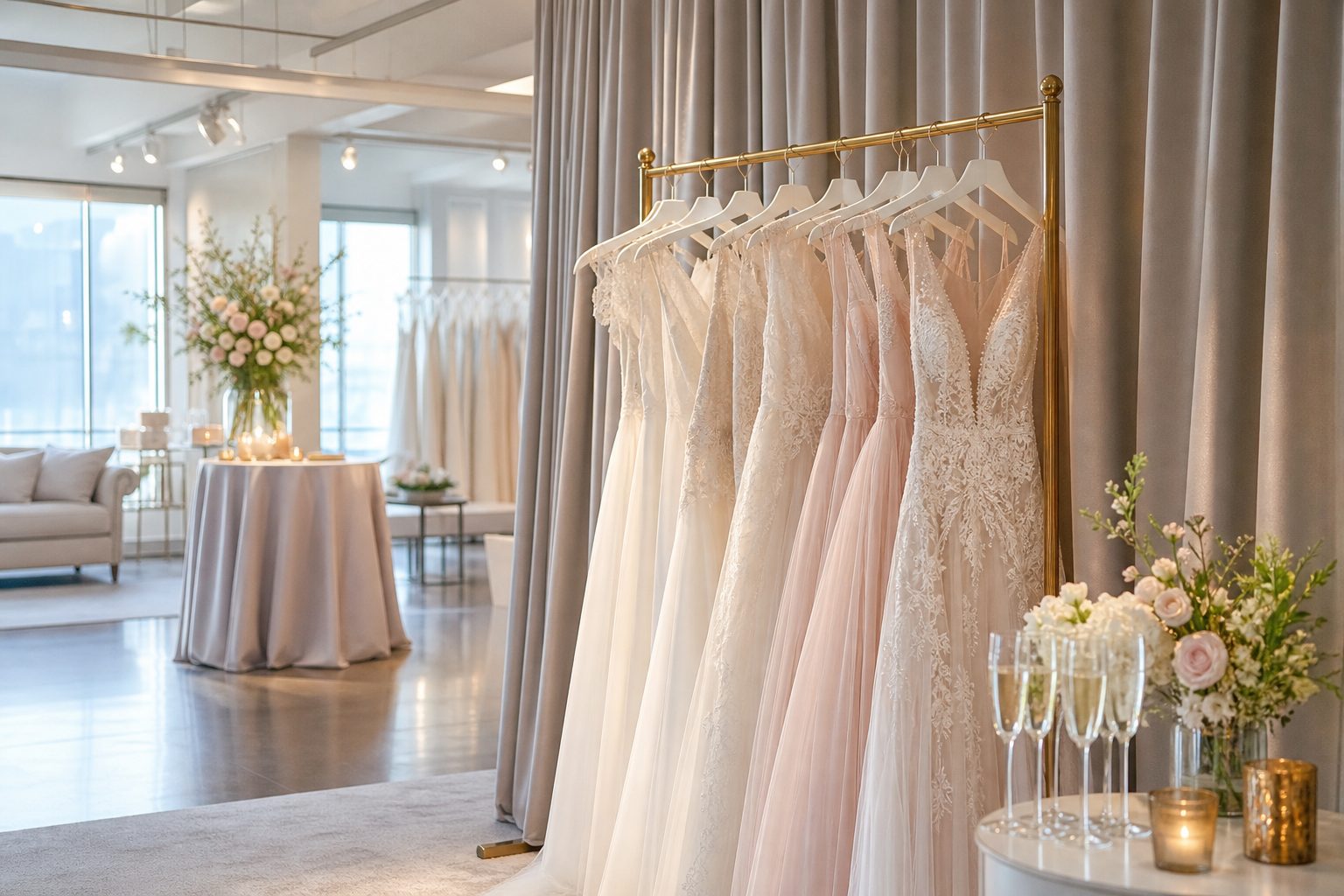
By treating it as a weekend of manufacturing capacity rather than a party. A trunk show makes money when you fill enough appointment slots at a high enough close rate to cover the freight, the staffing, the marketing and the discount you funded. Miss on slot count or close rate and the event is a loss dressed up in flowers.
The good news is that all four of those variables are knowable before the samples arrive. You can build the whole thing on paper in an afternoon and decide whether the numbers work at your average gown price.
Here is how a three day designer event actually runs in a shop with four fitting rooms, where the money comes from, and the two places owners consistently underestimate the cost.
What the designer supplies and what you pay for
The designer sends a collection of loaner samples, typically the current season, often twenty to forty gowns depending on the house and your floor space. Some send a representative or a regional rep to work the floor with you. Some send nothing but a shipping label and a deadline.
You supply everything else. The floor, the racks, the steamers, the staff, the marketing spend, the food and drink, and usually the return freight.
Get the terms in writing before you commit the dates. The specific things to pin down:
- How many samples, in what size range, arriving on what date
- Who pays inbound freight and who pays return freight
- Whether a rep attends and whether you cover their travel or hotel
- The exact return ship date and what happens if you miss it
- Whether you may sell the samples off the rack at the end, and at what price
- Whether the designer contributes to advertising, and in what form
- Minimum order commitment, if any, attached to hosting
The minimum order clause
Some houses attach a minimum to a trunk show: host the event, commit to a certain number of orders or a dollar figure of stock for the season. That converts an event risk into an inventory risk. It is not automatically bad, but price it as inventory you are buying, not as a cost of the weekend.
Keep reading: Is the shift toward shorter engagements changing how I stock and schedule my shop?
Freight, insurance and the return deadline on loaner samples
Forty gowns move in wardrobe boxes or rolling racks and they are heavy. Round trip freight on a full collection is real money, and it is the line owners forget when they sketch the event on a napkin.
Insurance is the more serious exposure. Loaner samples are the designer's property and they are in your custody. Check whether your commercial policy covers property of others on premises, and at what limit. A forty gown collection at a wholesale value of $900 each is $36,000 sitting on your floor for four days. If your policy caps bailee coverage at $10,000, you have a gap. Call your agent before the boxes ship, not after.
The return deadline is not soft. The next shop on the tour is expecting those samples. Build the return into the schedule as a hard task with a named person: steam, count against the packing list, photograph any damage, box, and hand to the carrier by the stated date. Missing it can cost you the relationship and sometimes a fee.
Appointment slots: how many fit in a weekend and at what length
This is the arithmetic that decides the event.
Assume four fitting rooms and a ninety minute trunk show appointment, which is longer than a regular appointment because the bride is seeing an unfamiliar collection and often ordering the same day. Assume Friday noon to seven, Saturday ten to six, Sunday eleven to five, with a thirty minute reset between appointments.
| Day | Hours open | Slots per room | Rooms | Total slots |
|---|---|---|---|---|
| Friday | 7 | 3 | 4 | 12 |
| Saturday | 8 | 4 | 4 | 16 |
| Sunday | 6 | 3 | 4 | 12 |
| Total capacity | 40 | |||
Forty is the ceiling, not the plan. Hold back two slots per day for walk ins and for the bride who needs a second look on Sunday after sleeping on it. Plan for 34 booked appointments and treat anything above 30 as a full house.
Whether to shorten the appointment
Cutting to seventy five minutes adds roughly five slots across the weekend. It also cuts the time a consultant has to move a bride from liking a gown to signing for it. In a same weekend order event, the close is the product. Do not shorten the appointment to chase volume unless your consultants routinely close inside an hour on a normal Saturday.
Staffing the floor and the fitting rooms for volume
One consultant per fitting room is the baseline, and it is not enough on its own. At full capacity you also need a floor lead running the board, a runner keeping gowns steamed and returned to the correct rack, and someone at the front handling arrivals, drinks and the phone.
For the Saturday above: four consultants, one lead, one runner, one front desk. Seven people for eight hours. At a blended $22 an hour that is $1,232 for Saturday alone, before any consultant commission on orders written.
The runner is the role owners cut first and regret. With forty loaner samples cycling through four rooms, gowns get mis racked within two hours if nobody owns the rack. A mis racked sample is a gown the next bride never sees.
Keep reading: What should I check on a gown the day it arrives from the designer before I call the bride?
The trunk show discount and who funds it
The standard offer is a percentage off the gown for orders placed during the event, commonly ten percent. The question that decides your margin is who absorbs it.
Three structures exist. The designer funds it by discounting your wholesale cost on event orders. You fund it out of your own margin. Or you split it.
Take a gown with a $1,300 wholesale cost and a $2,600 retail price, a keystone markup. That is $1,300 of gross margin.
- Designer funds the full ten percent: you sell at $2,340, wholesale drops to $1,040, margin holds at $1,300
- You fund it: you sell at $2,340, wholesale stays $1,300, margin falls to $1,040, a 20 percent cut in gross margin per gown
- Split evenly: margin lands at $1,170
If you are funding the discount alone, the event has to generate enough incremental orders to make up a fifth of the margin on every gown sold that weekend. That is a much higher bar than most owners realize when they agree to the offer on a phone call.
Turning a same weekend deposit into a confirmed order
A trunk show discount that survives the weekend is not a trunk show discount. The urgency is the mechanic, and it only works if the terms are unambiguous and the paperwork is ready before the doors open.
Have the following prepared in advance, not written on the fly at the desk:
- A deposit amount and policy stated on the price sheet, not negotiated per bride
- The designer's current size chart and delivery lead time, printed and at the desk
- A measurement sheet the consultant fills in before the bride leaves the room
- A written order form that captures style, color, size, any custom request and the agreed delivery window
- A card on file authorization and a clear statement that special orders are nonrefundable
The bride who says she needs to think about it is a normal outcome. Give her a stated deadline, commonly the Wednesday after, and put it in writing on the day. An open ended offer produces neither urgency nor a clean close.
See how VeilFittings handles this for bridal retail and alterations
After the event: order entry, sizing decisions and the follow up window
Monday is where the weekend gets won or lost a second time. Every order written over three chaotic days now has to be entered correctly against a designer size chart, with the delivery date calculated back from a wedding date, and any custom request confirmed with the house before the order goes in.
Sizing is the recurring failure. A bride between a 10 and a 12 with a fitted bodice and a nine month runway is a different decision from the same bride with a five month runway. Size up decisions create alterations work, and alterations work has to land on a seamstress calendar that already has the rest of your book on it. Decide sizing with the alterations load in view, not just the measurement.
Work the undecided list inside seventy two hours while the gown is still vivid. After a week the memory of the collection has faded and you are selling from a photograph.
Reading the numbers afterward to decide on a repeat
Build one page after every event and keep it. Booked appointments, kept appointments, orders written, average order value, total gown revenue, and against that: freight, staffing hours and cost, marketing spend, food and drink, discount funded by you, and any sample damage you covered.
Run a plain example. Thirty two kept appointments, a 40 percent close rate is thirteen orders, average gown $2,600 at the discounted price of $2,340, giving $30,420 of gown revenue. At a self funded ten percent, margin is roughly $1,040 per gown, so $13,520 gross margin. Against costs of, say, $2,800 staffing, $900 freight, $1,200 marketing, $400 hospitality, the event clears about $8,200 before accessories and before the alterations revenue that follows every one of those thirteen gowns. Those are illustrative assumptions, but the structure is the point: close rate and slot count move that number far more than anything you spend on flowers.
Repeat the event when the close rate holds above your normal Saturday rate and the collection sells at your price point. Drop it when you filled the slots but wrote four orders, because that is a collection mismatch, not an effort problem.
Where the board comes in
A trunk show is thirty something appointments, a stack of same weekend orders and a return freight deadline, all landing on a calendar that already holds every other bride in your book.
VeilFittings holds the appointment schedule, the resulting gown orders and the alteration fittings that follow on one board the whole shop can read, so Monday's order entry runs off what the consultants actually recorded in the room and the thirteen new delivery dates slot in against the seamstress capacity you already have. Plan the weekend on paper, then run it somewhere the whole team can see the same thing.
Read also
Is the shift toward shorter engagements changing how I stock and schedule my shop?
More brides are shopping inside a nine month window. What that does to special order viability, off the rack inventory depth, sample size range, and your alterations calendar.
What should I check on a gown the day it arrives from the designer before I call the bride?
Receiving inspection is your only clean window for a claim. A step by step check of shade, sizing, construction and hardware to run before the gown ever goes on a hold rack.
How many fitting appointments does one gown really take from first pin to pickup?
Two fittings is the number most shops quote and rarely the number they deliver. A breakdown of appointment counts, chair time per stage and how to schedule the room around real duration.