numbers and benchmarks
How many fitting appointments does one gown really take from first pin to pickup?
Two fittings is the number most shops quote and rarely the number they deliver. A breakdown of appointment counts, chair time per stage and how to schedule the room around real duration.

Three appointments is the honest baseline for a straightforward gown, and four is common the moment beading, a cathedral train or a body that is still changing enters the picture. The two fitting promise that shops put on their alterations agreement is a marketing number, not a production number, and the gap between the two is where your fitting room falls behind every spring.
The count itself is not the whole problem. Chair time per appointment varies more than appointment count does. A first fitting on a simple crepe sheath can be done in forty minutes. A first fitting on a fully beaded ballgown with a corset back and a bride who brought the wrong shoes is ninety minutes and you will not make it back up later in the day.
So the useful question is not how many fittings. It is how many hours of room and how many hours of seamstress, and whether your booking grid reflects them.
The standard three stage fitting sequence and what happens in each
Most alterations shops run the same arc, whatever they call the stages.
Stage one, the pin fitting
The bride wears her actual undergarments and her actual shoes. You pin the side seams, mark the hem from the floor with her posture and heel height, decide the bustle style, and check whether the straps, the bodice length and the neckline sit where she wants them. Nothing is cut. Everything is written down and priced.
Stage two, the check fitting
The major work is done and basted or sewn. She tries it on, you confirm the side seams and hem, you fix what moved, and you install or refine the bustle. This is the appointment where a hem that reads long by half an inch gets corrected while there is still time.
Stage three, the final
Everything is finished and pressed. She wears the full look, you check her sitting, walking and lifting her arms, and you teach whoever is bustling to bustle. She leaves with the gown or you hold it for pickup.
Keep reading: What does a bustle really cost to build, and why do brides argue about the price?
Chair time per stage on a simple gown versus a beaded one
These are planning figures from the way the work actually runs, not survey data. Adjust them to your own shop after a month of honest timing.
| Stage | Simple gown, crepe or satin | Beaded or lace, long train |
|---|---|---|
| Pin fitting | 45 minutes | 75 to 90 minutes |
| Check fitting | 30 minutes | 45 to 60 minutes |
| Final and bustle lesson | 30 minutes | 45 minutes |
| Total room time | About 1 hour 45 | About 3 hours |
The beaded column runs long for reasons that are physical, not personality. Getting a heavy gown on and off takes two people and several minutes each way. Pinning through beading means hand picking beads off the seam line before anything can be marked. A cathedral train has to be laid out and walked before you can judge a bustle, and the room has to be big enough to do it.
Room time is not seamstress bench time. The bench hours on that same beaded gown, side seams through beading, a horsehair hem, a nine point bustle, easily run past what your fitting room ever sees.
When a fourth fitting becomes necessary
A fourth fitting is not a failure. It is a predictable outcome of specific conditions, and you can name them at the first appointment.
- The gown came in more than two sizes large and the bodice is being substantially rebuilt.
- Beading has to be removed, seams moved, and beading reapplied by hand along the new line.
- The bride is actively losing or gaining weight, or is pregnant.
- Straps, sleeves or a neckline are being redesigned rather than adjusted.
- A second garment is in play: a reception dress, an overskirt, a detachable train.
- The first fitting happened without the correct shoes or undergarments.
Say it out loud at the pin fitting: this gown will most likely need four appointments, and here is why. A bride told in March accepts a fourth date. A bride told in July hears an upsell.
Weight change, undergarments and the timing of the first fitting
The common rule is to start alterations roughly eight to twelve weeks before the wedding, and it is a good rule for reasons of body change rather than sewing speed. Start too early and you fit a body that will not be there. Start too late and you have no room for a fourth appointment or for a mistake.
Undergarments decide more than brides expect. A bodice fitted over a longline bra fits differently than one fitted over sewn in cups, and shapewear changes the waist and hip by enough to matter. If she has not bought them yet, that is worth saying plainly: the pin fitting cannot be trusted without them, and a redo is a real appointment on a real calendar.
Shoes set the hem. A one inch difference in heel height is a one inch difference in hem, and a hem is the single most reworked item in bridal alterations. If the shoes are not decided, pin the hem long and plan a return.
Keep reading: How far out should I be ordering a bridal gown so it lands before the first fitting?
Bustle instruction and the final press appointment
The bustle lesson is a real appointment segment, not a courtesy at the door. Whoever will actually tie it, the mother, the maid of honor, sometimes the bride herself, has to do it twice with their own hands while you watch. Photograph the tied bustle and the loop and button pairs, and send her the photos.
Some shops separate the final press from the final fitting: the bride confirms fit at one appointment, then the gown is pressed, bagged and collected at a short pickup slot. That split is worth the calendar space, because a pressed gown that goes back on a body and gets creased again has to be pressed twice, and pressing a tulle ballgown is not fifteen minutes.
Fitting room turnover and how many gowns one seamstress can carry
Here is a worked calculation you can run on your own shop tomorrow. The inputs are assumptions. Replace them with your numbers.
- Assume one seamstress works 30 productive bench hours a week, after fittings, phone calls and interruptions.
- Assume an average gown consumes 9 bench hours: hem, side seams, bustle, and a strap or cup adjustment.
- 30 divided by 9 gives about 3.3 gowns finished per week.
- Assume each gown occupies a 6 week window from pin fitting to pickup.
- 3.3 gowns per week across a 6 week window means roughly 20 gowns open on her rack at any moment.
That number is the ceiling, and the ceiling is what gets violated in peak season. If you take on 30 open gowns for one seamstress in the same window, the arithmetic does not bend. Something moves: a hire, overtime, outsourcing hems, or a booking pause. Deciding which in April is management. Discovering it in June is a crisis.
Run the same math with your real average. A shop doing heavy beadwork may sit at 14 bench hours per gown, which cuts the same seamstress to about 13 open gowns.
See how VeilFittings handles this for bridal retail and alterations
Scheduling buffer between the last fitting and the wedding date
Set the final fitting at least two weeks before the wedding, and treat that fortnight as untouchable. It absorbs the thing you did not plan for: a hem that reads uneven under different light, a strap that slipped, a bride who lost an inch, a gown that has to be pressed again.
Then plan backward from the wedding date rather than forward from today.
- Wedding date.
- Minus 14 days: pickup, gown finished and pressed.
- Minus 21 days: final fitting.
- Minus 42 days: check fitting.
- Minus 63 days: pin fitting.
- Minus 70 days or earlier: bride has shoes and undergarments in hand.
Destination weddings pull all of it forward, because the gown has to travel. So does a bride with a bridal portrait session, which is effectively a second finished deadline weeks ahead of the first one, and it is the deadline shops most often miss because nobody wrote it down.
Tracking fitting counts so your quotes match your calendar
The fix is not a better guess. It is a record. For one season, log every gown by fabric type, appointment count and total room minutes. At the end of it you will know your real average by category, and you will price and book against your own history instead of an industry habit.
What you will probably find is that your beaded gowns take four appointments often enough that quoting three is a promise you break routinely, and that your seamstress capacity is the binding constraint rather than fitting room availability.
Putting the count on one board
Appointment counts only help if they sit next to the wedding date, the gown status and the person doing the work. VeilFittings holds the gown from deposit to pickup with every fitting appointment attached, and a seamstress workload view that shows how many open gowns each person is carrying against the dates they are due. When you book a fourth fitting, you can see immediately whether the week it lands in has room. That is the difference between a schedule you keep and a schedule you apologize for.
Read also
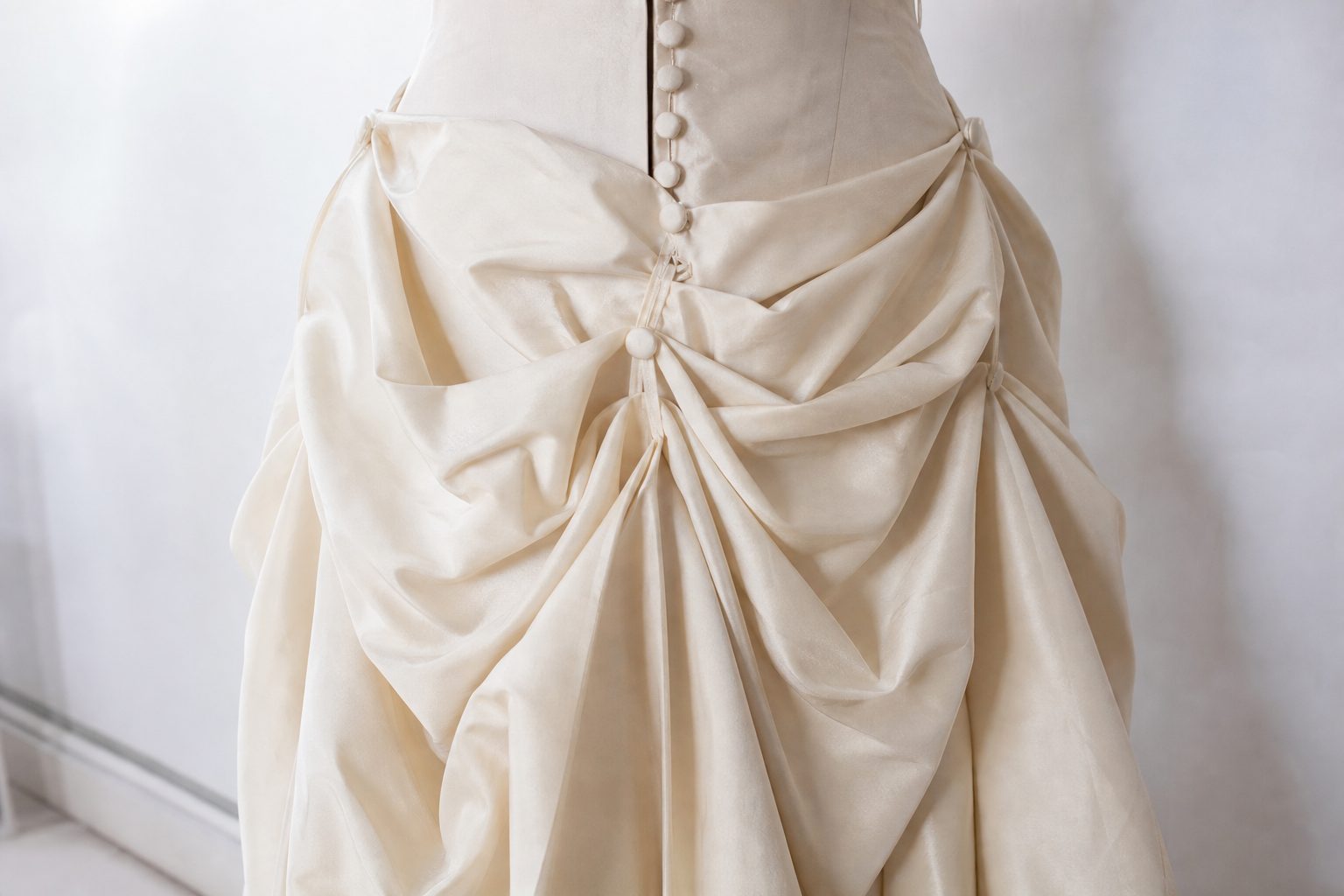
What does a bustle really cost to build, and why do brides argue about the price?
An American bustle on a cathedral train is hours of hand work hidden under a skirt. From the fitting room floor: how bustle types differ, what drives the labor, and how to explain it.
How far out should I be ordering a bridal gown so it lands before the first fitting?
Designer production windows, shipping, and your own alterations calendar all stack. Here is how to work backward from the wedding date and build the buffer that keeps a rush cut off the invoice.
Should I price alterations by the piece or by the hour in my bridal shop?
Flat per-task menus read cleanly to a bride but bleed margin on couture. Hourly protects the seamstress and unsettles the customer. A working comparison of both models for a bridal fitting room.