comparison
Should I price alterations by the piece or by the hour in my bridal shop?
Flat per-task menus read cleanly to a bride but bleed margin on couture. Hourly protects the seamstress and unsettles the customer. A working comparison of both models for a bridal fitting room.
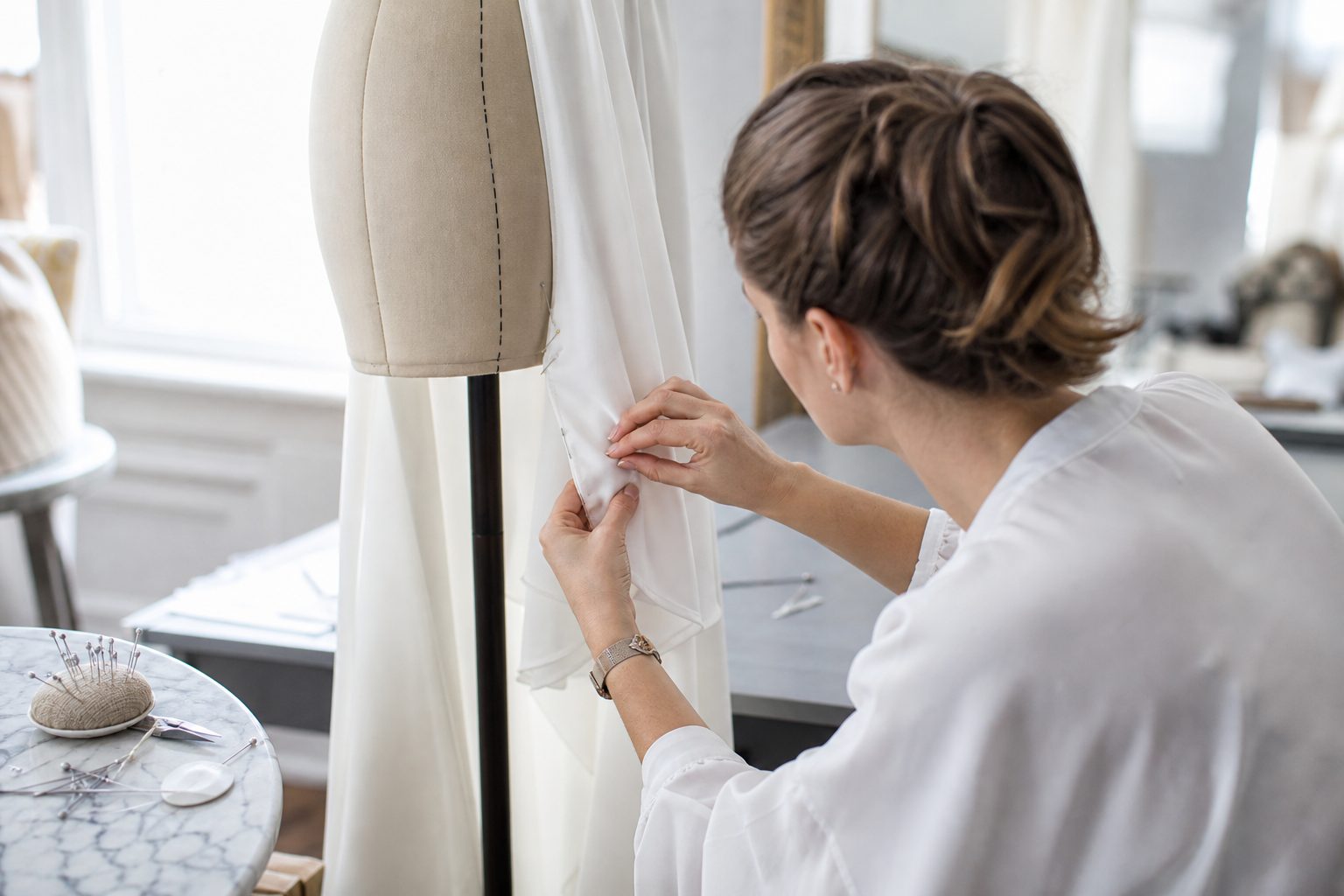
Price the predictable work per piece and the unpredictable work per hour. A hem, a bustle, a standard side seam and a strap shorten all have known labor times, so a flat menu price is fair to both sides and takes ten seconds to quote. Beading removal and reapplication, lace reweaving, corset back conversions and anything involving a couture interior have labor times that swing by a factor of four, and a flat price on those is a guess you will lose more often than you win.
Most bridal shops that stay profitable end up hybrid without ever calling it that. The menu carries the volume, the hourly line carries the risk, and the estimate sheet keeps the bride from feeling like the number moved.
What follows is the margin math on each model, where the crossover sits, and how to write an estimate that holds up when a gown needs a third fitting.
What a per-piece alterations menu usually covers
A per-piece menu is a published list of discrete tasks with a fixed price each. It works because these tasks are physically bounded. A machine hem on a lined A-line with a single layer of lining takes a known amount of time on your bench, every time, regardless of who the bride is.
A typical bridal menu covers hemming by construction type, taking in or letting out side seams by number of seams, bustles by point count, strap and sleeve adjustments, cup and bra insertion, and zipper replacement. Each of those has a repeatable motion sequence.
The menu earns its keep at the quote. When a bride asks what alterations will run, a shop with a menu answers in one breath with a number she can hold. A shop without one says it depends, and the bride hears evasion.
Where the menu quietly leaks
Menus leak when the price is written for the easy version of the task and applied to the hard version. A hem is a hem until it is a horsehair braid edge over four layers of tulle with a scalloped lace border that must be cut off, shortened, and hand reapplied so the scallop still reads at the floor.
The fix is not to abandon the menu. It is to write the menu by construction, not by task name. Hem, single layer lined. Hem, multi layer tulle. Hem, lace border with reapplication, quoted hourly. Three lines instead of one, and the hard case has already left the menu before it reaches your bench.
Keep reading: What goes wrong when a bride brings her own seamstress into my alterations process?
Where hourly billing protects you: beading, lace, corset conversions
Hourly belongs anywhere the work is hand finish and the quantity is unknown until you open the garment.
- Beading. Taking in a heavily beaded side seam means clipping and removing beads along the seam line, sewing the seam, then hand replacing beads across the join so the pattern is continuous. The number of beads is not knowable from the outside.
- Lace. Appliqued lace crossing a seam has to be released, the seam taken, and the motif reset so it reads unbroken. Some lace can be cut and butted, some has to be rebuilt.
- Corset conversion. Converting a zipper back to a corset back is a rebuild: removing the zipper, adding a modesty panel, setting grommets or hand worked eyelets into a boned foundation, and rebalancing the bodice. Hours vary with the existing interior construction.
- Sleeve creation. Adding sleeves from matching lace bought separately is design work plus labor, and the design part is unbillable if you quoted flat.
The honest reason to bill these hourly is that you cannot see the interior at the consultation. You can see it at the first fitting, once the gown is on the body and the pins are in. That is the correct moment to convert an hourly estimate into a range.
How each model reads to a bride at the quote
A menu reads as a price list, which reads as a store. An hourly rate reads as a professional service, which reads as a lawyer. Both are legitimate, but they trigger different anxieties.
| Per piece | Hourly | |
|---|---|---|
| What she hears | A number she can budget | An open meter |
| Her first question | Why is a bustle that much | How many hours will it be |
| Where you are exposed | Underquoting couture | Every hour above the estimate |
| Best for | Hem, bustle, simple seams | Beading, lace, rebuilds |
| Disputes come from | Scope creep inside the flat price | The final number exceeding the estimate |
The practical answer to the open meter objection is a not-to-exceed number. Quote the hourly rate, estimate the hours, and state a ceiling you will not pass without calling her. Brides accept an hourly rate readily once there is a ceiling attached.
Keep reading: Do I need to collect sales tax on alterations if the gown was purchased in my store?
Margin math on a hem, a bustle, and a full side seam
Work this with your own numbers. The assumptions below are illustrative only, not survey data.
Assume a seamstress costs you $32 an hour fully loaded, meaning wage plus payroll taxes plus your share of benefits and paid time. Assume your fitting room overhead, meaning rent, utilities, the fitting room's share of your lease, notions and thread, allocates at $18 an hour of bench time. Your true cost of bench time is therefore $50 an hour, or about $0.83 a minute.
| Task | Bench minutes | Cost at $50/hr | Menu price | Gross margin |
|---|---|---|---|---|
| Hem, single layer lined, machine | 75 | $62 | $185 | $123 |
| Hem, four layer tulle with horsehair | 210 | $175 | $185 | $10 |
| American bustle, 5 point | 60 | $50 | $150 | $100 |
| Take in both side seams, unbeaded | 90 | $75 | $195 | $120 |
| Take in both side seams, beaded | 300 | $250 | $195 | negative $55 |
Two rows are the whole argument. The single hem line priced flat at $185 covers a simple hem beautifully and covers a tulle hem barely. The beaded side seam priced flat loses money on every gown, and the busier your shop gets the faster you lose it.
Split those two rows out to hourly at a billed rate of $95 an hour and the beaded seam invoices at about $475 against $250 of cost. That is not gouging. That is five hours of skilled hand work priced like five hours of skilled hand work.
Handling a gown that needs three fittings instead of two
Two fittings is the plan. Three happens when the body changes, when the bride changes her mind about length after seeing shoes, or when the first alteration reveals a balance problem that only shows once the primary work is done.
Decide in advance which of those you eat. A fair split: you absorb the third fitting when it exists because of your own fit call, and you bill it when it exists because of a change the bride requested or a measurement change on her side.
Write the policy on the estimate. Something like: the quoted price includes two fittings plus pickup; additional fittings required by changes to the bride's measurements or requested design changes are billed at the hourly rate with a minimum of one hour. Nobody argues with a rule they signed.
See how VeilFittings handles this for bridal retail and alterations
In-house seamstress versus contract: how pay structure drives your model
Your billing model should mirror how you pay the bench, or you will carry the mismatch yourself.
- Hourly employee. Your cost is time. Bill hourly on anything variable and your exposure disappears. A flat menu on a slow worker is your loss, not hers.
- Contract seamstress paid per garment or per task. Your cost is fixed per task, so a per-piece menu is a clean pass through with a known spread. Just make sure her per-task schedule matches your menu categories, including the hard variants.
- Commission or revenue split. Whatever model you quote, she is exposed to the same variance you are, which means she will resist taking the beaded gowns unless the split reflects the hours.
If you employ someone hourly and quote everything flat, you have taken all the variance onto the shop. That is a choice, and it is survivable at volume with a well written menu. It is not survivable if a third of your book is couture.
Quoting a hybrid: menu base plus hourly on hand-finish work
The hybrid quote has three parts and fits on one page.
- Menu lines. Each named task at its published price, listed and totaled.
- Hourly lines. Each hand finish item with an estimated hour range, the rate, and a not-to-exceed ceiling.
- The total range. A low figure assuming the bottom of every hourly estimate, and a high figure at every ceiling. Give her both numbers.
Say the range out loud at the fitting. Between $640 and $890 depending on how the beading behaves on the left seam, and I will call you before I go past $890. A bride who hears that sentence almost never disputes the invoice, because you told her the truth before you had to.
Putting the estimate in writing before scissors touch fabric
No cutting without a signature. That is the rule that prevents almost every alterations dispute in a bridal shop, and the reason is simple: once the gown is cut, the bride cannot walk away and you cannot undo the work, so both of you need to have agreed on the number while the gown was still whole.
Your estimate should carry the gown identification, the date of the fitting, each task with its price or hour estimate, the total range, the fitting and pickup dates, the third fitting policy, and a signature. Give her a copy. Keep yours attached to the gown record, not in a binder.
Once the estimate is signed, the work has to reach the right bench in the right week, which is where most shops actually lose the margin they just protected. Keeping each gown's alteration tasks, its estimate, its fitting dates and the seamstress hours those tasks consume on one shared board is what VeilFittings does, so you can see this week's committed bench hours before you promise a bride a Saturday.
Read also
What goes wrong when a bride brings her own seamstress into my alterations process?
Outside alterations are common and legitimate, but they blur liability on a gown you sold. The handoff mistakes that turn into a chargeback, and the release language that prevents them.

Do I need to collect sales tax on alterations if the gown was purchased in my store?
Taxability of alteration labor varies by state and often turns on whether the service is bundled with the sale of the gown. How to read your own state rule and invoice correctly.
How does a small bridal boutique actually run a designer trunk show without losing money?
A trunk show brings a full collection and a hard weekend deadline. A walk through the real cost lines, the appointment structure, and where a three day event turns profitable or not.