mistakes to avoid
What goes wrong when a bride brings her own seamstress into my alterations process?
Outside alterations are common and legitimate, but they blur liability on a gown you sold. The handoff mistakes that turn into a chargeback, and the release language that prevents them.
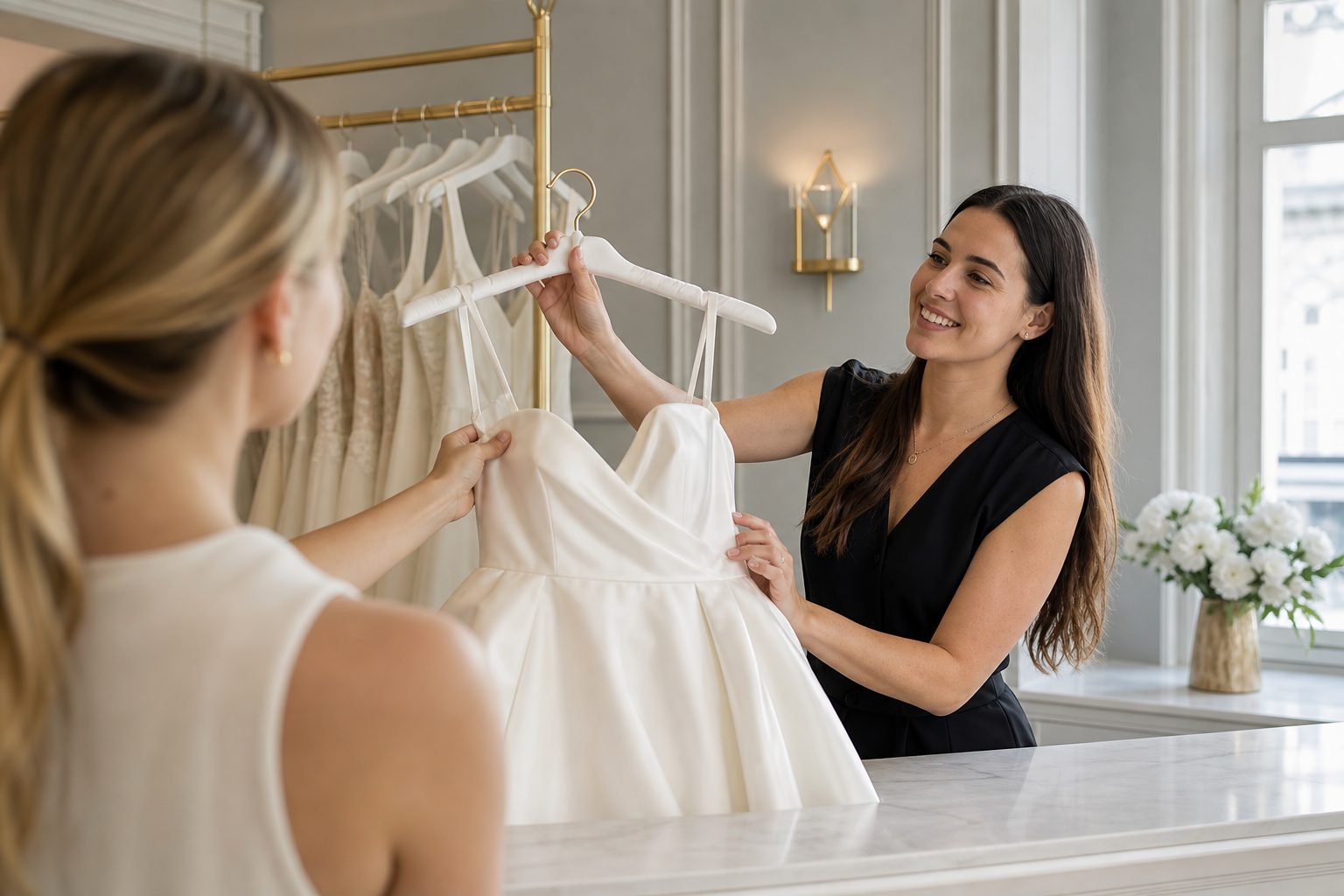
What goes wrong is that liability follows the gown but the bride's memory follows the receipt. She bought the dress from you, so when a hem comes out short, a bodice is cut crooked or a lace motif is destroyed at an outside shop, you are the business she can name, the business with her card on file, and the business her mother will call. The alterations happened somewhere else, but the chargeback lands on your merchant account.
Outside alterations are perfectly legitimate. Plenty of brides have a family seamstress, a tailor they trust, or a budget that only works if someone's aunt does the hem. The problem is never that they left. The problem is a handoff with no documented condition, no signed acknowledgment of where your responsibility ends, and a staff member who said sure, no problem instead of saying the one sentence that would have protected the shop.
Here is where the liability line actually sits, how to document the handoff in about four minutes, and the language that keeps a dispute from becoming a refund.
Where responsibility ends when the gown leaves your rack
You are responsible for two things: that the gown you delivered is the gown that was ordered, in the condition disclosed, and that any work performed by your bench was performed competently. That is it.
You are not responsible for the fit of a garment altered by a third party, for damage occurring after the gown left your premises, or for a bride's decision to have a $4,000 gown cut by someone with no bridal experience. But you only get to rely on that if the condition at the moment of transfer is a documented fact rather than a competing memory.
The transfer moment matters more than the paperwork. The gown leaves your hands, in her hands, on a specific date, in a specific condition. Everything after that instant is hers. Everything before it is yours. Make that instant a record.
The three questions that decide any later dispute
- Was the gown correct and undamaged when it left? Photographs answer this.
- Did the bride know and accept that outside alterations end your responsibility? A signed release answers this.
- Was the damage caused by alteration work or by a manufacturing defect? Condition photographs plus the designer's inspection answer this.
Shops that lose these disputes usually cannot answer the first question. Not because they are careless, but because the gown went out during a busy Saturday and nobody stopped to photograph it.
Keep reading: Do I need to collect sales tax on alterations if the gown was purchased in my store?
Damage claims on a gown altered elsewhere
The common claims are predictable, and each has a distinguishing signature you can point to.
| Claim | Usual outside cause | What distinguishes it from a defect |
|---|---|---|
| Hem is uneven | Measured without the correct shoes or on a soft floor | Manufacturing hems are cut to a level pattern line, not a body |
| Lace border destroyed | Cut straight through instead of released and reapplied | A clean scissor line through a motif is not a factory edge |
| Bodice puckers at the side seam | Seam taken without releasing the boning or lining | Original seams are graded and pressed, altered ones often are not |
| Beading missing along a seam | Beads clipped and not replaced after taking in | Loss follows the new seam line exactly |
| Zipper failure | Bodice taken in with tension across the closure | Strain distortion shows in the fabric either side of the teeth |
When a bride returns with one of these, your posture should be curious, not defensive. Look at the gown. Name what you see, factually and without characterizing the other seamstress. The lace has been cut through here rather than released and reset, which is a change made after the gown left us.
Documenting condition at pickup with photographs
This takes four minutes and it is the cheapest insurance in the building. Do it every time a gown leaves for outside alterations, without exception, including for the bride you like.
- Hang the gown on a padded hanger against a plain wall in even light.
- Photograph front, back, and both sides, full length.
- Photograph the hem edge, the closure, the interior at the side seams, and any beading or lace detail close up.
- Photograph the designer label and size tag in the same session so the images are tied to this specific gown.
- Photograph any preexisting flaw you already disclosed, such as sample rail wear, so it cannot be claimed later.
- Attach the images to the gown's record with the date, the staff member's name, and who collected it.
Do it in front of the bride and say why in one friendly sentence. I photograph every gown as it leaves so we both have a record of how it looked today. Nobody has ever objected to that. It also, quietly, communicates that you take the garment seriously.
Keep reading: How does a small bridal boutique actually run a designer trunk show without losing money?
The release form and what it should actually say
Keep it to one page and keep it readable. A release the bride skims and signs is worth more than a dense paragraph she never reads and later claims she did not understand. Have your own attorney review the final wording for your state.
The elements worth including:
- Identification of the gown: designer, style, size, order number, and the date of collection.
- A statement that the bride has elected to have alterations performed by a party other than the shop.
- Acknowledgment that the gown was inspected together at collection and was in the condition shown in the attached photographs.
- A statement that the shop is not responsible for fit, workmanship, damage or loss occurring after collection.
- An acknowledgment that alteration by a third party may affect the ability to pursue a designer defect claim.
- A note that the shop is under no obligation to correct or complete outside work, and that any such work, if accepted, is quoted separately.
- Date, printed name, and signature. Give her a copy.
What the release should not do is scold. Language that reads as a warning against the bride's choice makes her defensive and makes the signature feel like a trap. Neutral and factual signs faster.
Answering a bride who asks you to fix outside work
She will ask. Sometimes two weeks before the wedding, sometimes four days. You have a real choice, and the wrong instinct is to refuse reflexively or to accept reflexively.
Take the work only if three things are true: your bench has genuine capacity in the window, the gown is recoverable, and the bride accepts a new written estimate at your hourly rate with no warranty on the prior work. Repair of another shop's work is almost always hourly, never menu priced, because you are diagnosing before you are sewing.
The sentence that works: I can look at it, and if it is fixable I will give you a written estimate today. Because this work was done elsewhere, I have to charge by the hour, and I cannot guarantee the result of correcting someone else's alteration. That is honest, it is not a lecture, and it leaves her a decision to make rather than a verdict to accept.
If your bench genuinely has no room, say so early and clearly. A rescue you cannot finish is worse for her than a referral you give her on Monday.
See how VeilFittings handles this for bridal retail and alterations
Fitting room use policy for gowns you did not alter
A frequent and awkward request: the bride wants to use your fitting room, your mirror, your steamer or your pressing table for a gown being altered elsewhere. Sometimes she wants your consultant's opinion on the outside seamstress's work.
Decide the policy once and write it down, so it is not a judgment call by whoever is on the floor at 4pm on a Saturday. Reasonable options, any of which is defensible:
- Fitting rooms are reserved for appointments and for gowns in your own alterations program.
- Fitting room use for outside gowns is available by appointment at a flat room fee.
- Steaming and pressing are offered as a paid service with a signed acknowledgment of condition, same as any handling.
The one thing to avoid is a consultant giving an informal opinion on outside workmanship in your mirror. That opinion becomes evidence in a dispute with the other seamstress, and it drags your shop into a fight that was never yours.
Warranty and designer defect claims after outside alteration
Most bridal houses will consider a defect claim on an unaltered gown: a failed seam from production, a fabric flaw, a missing component. Once a third party has cut, taken in or reconstructed the garment, the house will usually decline, because it can no longer establish that the fault originated in production.
This is not the designer being difficult. It is the same logic as any manufacturing warranty. The moment the article is modified outside the maker's specification, causation becomes unprovable.
The practical consequence for you: inspect thoroughly at receiving, and raise any defect with the house before the gown goes out for outside alterations, not after. A pulled thread noticed at unbagging is a designer conversation. The same pulled thread noticed after an outside hem is your problem or hers.
Training staff to say it clearly without losing the sale
Your team needs one short script and permission to use it. The failure is almost never rudeness, it is a consultant who does not want to sound negative and so says nothing at all.
Give them this shape: acknowledge the choice, state the two facts, produce the paperwork. Absolutely, plenty of brides use their own seamstress. Two things I need to do before it goes: photograph the gown with you so we both have a record, and have you sign the collection form. It takes about five minutes.
Then role play it, twice, with a real gown and a real form, before anyone does it with a customer. A script read for the first time in front of a bride sounds like a script. A script practiced twice sounds like the shop's normal process, which is exactly what it is.
Where this falls apart in practice is retrieval: the photographs on someone's phone, the signed form in a drawer, the collection date remembered by one person who is off that week. Keeping each gown's condition photographs, signed release, collection date and fitting history attached to the gown record on one board the whole shop can read is what VeilFittings is for, so the answer to a dispute six weeks later takes thirty seconds rather than an afternoon.
Read also

Do I need to collect sales tax on alterations if the gown was purchased in my store?
Taxability of alteration labor varies by state and often turns on whether the service is bundled with the sale of the gown. How to read your own state rule and invoice correctly.
How does a small bridal boutique actually run a designer trunk show without losing money?
A trunk show brings a full collection and a hard weekend deadline. A walk through the real cost lines, the appointment structure, and where a three day event turns profitable or not.
Is the shift toward shorter engagements changing how I stock and schedule my shop?
More brides are shopping inside a nine month window. What that does to special order viability, off the rack inventory depth, sample size range, and your alterations calendar.